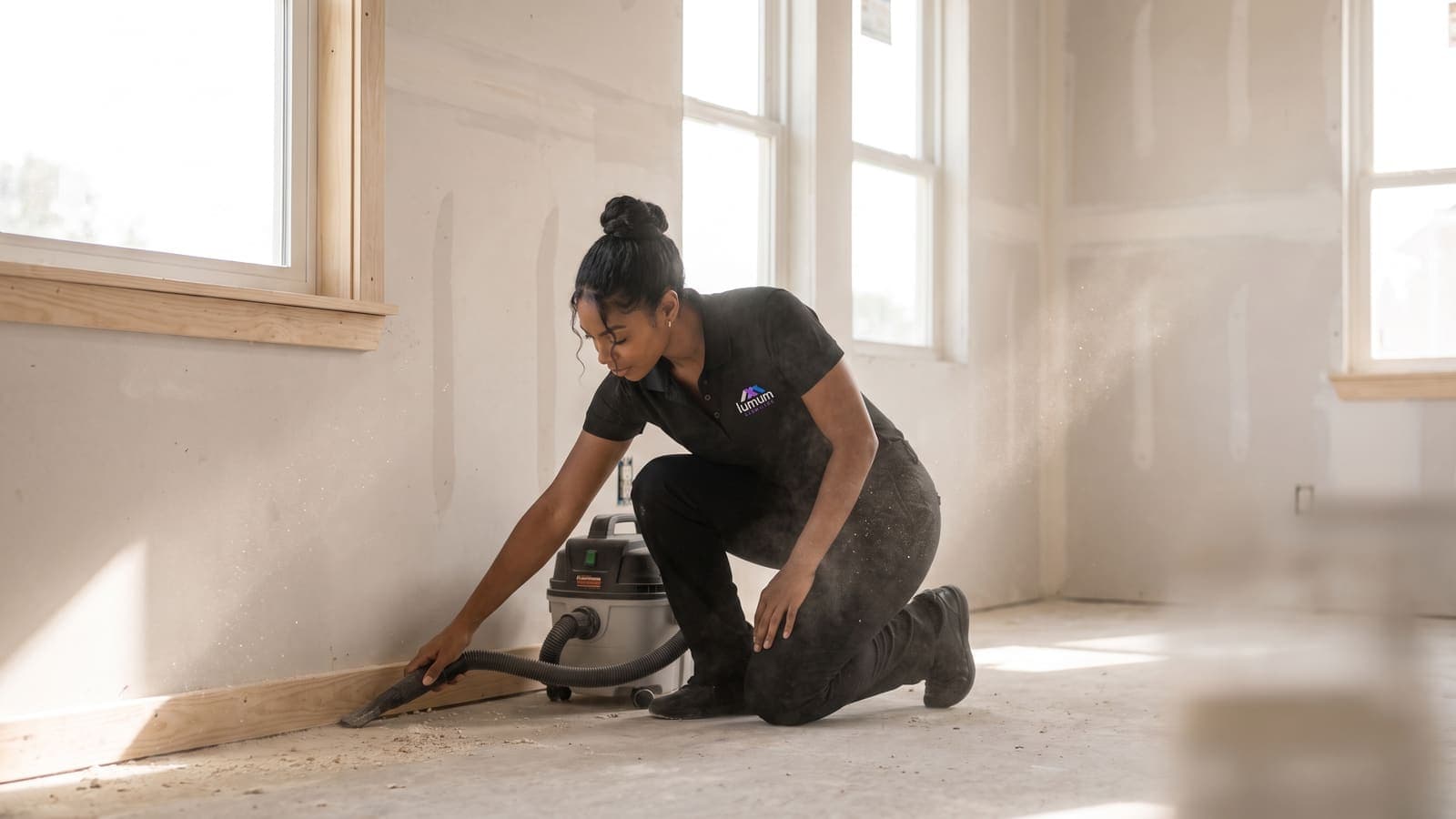
Fine drywall dust is measured in microns. It does not sit on surfaces the way household dust does, it suspends in the air and settles for days. That single property is why post-construction cleaning is a different trade and why an ordinary clean fails at it.
The complaint is always the same: it was cleaned, and a week later there is dust on everything again. That is not poor work. It is the wrong method for the material.
Why the dust behaves differently
Household dust is mostly fabric fibres and skin, and it is heavy enough to stay where it lands. Drywall dust is ground gypsum: light, fine, and electrostatically inclined to cling. It gets into wall cavities, light fittings, HVAC returns and the gaps around trim, and it keeps releasing for days after the work stops.
Why an ordinary clean makes it worse
- A standard vacuum passes the finest particles straight through the filter and back into the air
- Dry sweeping lifts far more than it collects
- A damp cloth on heavy dust makes a slurry that smears into porous surfaces
- Cleaning while dust is still airborne means it lands on what you just finished
What the job actually requires
- 1HEPA-filtered vacuums, which capture the particle sizes that matter rather than recirculating them.
- 2Working top to bottom, so what falls lands on surfaces still to be done.
- 3Settling time between passes. This is the part nobody wants to pay for and the part that decides whether it works.
- 4Residue work that has nothing to do with dust: adhesive, paint flecks, grout haze, stickers on glass and fixtures.
Timing is the whole game
Book it only when every trade is genuinely finished. One more cut, one more sanding pass, and the floor is re-dusted — and you have paid for a clean you now need again. This is the most common and most expensive scheduling mistake on a build.
Why it prices where it does
Roughly three times as long per square foot as ordinary cleaning, with specialist equipment and a staged schedule. Priced per square foot with a minimum, because a small remodel still needs the same method as a large one.